AI Search Optimization is changing how businesses improve their online visibility. Instead of focusing only on traditional Google rankings, website owners now want their content to appear in AI-powered search experiences such as ChatGPT, Perplexity, and Google AI Overviews.
The good news is that the fundamentals have not completely changed. Strong technical SEO, helpful content, clear website structure, trustworthy information, and a good user experience remain important.
As more people use AI tools to research products, compare services, and find answers, businesses need to understand how their websites can become useful sources for these experiences. This guide explains AI search engine optimization, the strategies that matter, useful tools, and practical ways to improve your website’s AI search visibility in 2026.
What Is AI Search Optimization?
AI Search Optimization is the process of improving a website’s content, technical structure, and credibility so that AI-powered search systems can discover, understand, and potentially reference its information.
Traditional SEO focuses mainly on helping web pages appear in search engine results. AI search optimization expands this approach by making website information easy for search systems to understand and connect with users’ questions.
You may also see related terms such as:
- Answer Engine Optimization (AEO)
- Generative Engine Optimization (GEO)
- AI SEO
- AI Search Engine Optimization
Although these terms can have slightly different meanings, the practical goal is similar: create useful, trustworthy, accessible content that directly answers real user questions.
“Important: AI search optimization cannot guarantee that your website will appear in ChatGPT, Perplexity, or Google AI results. Visibility depends on factors such as relevance, indexing, content quality, authority, and the systems used by each platform”
Why AI Search Optimization Matters in 2026
Search behavior is changing as users increasingly ask complete, conversational questions instead of entering short keywords.
For example, instead of searching:
“best website platform”
a user might ask:
“What website platform is best for a small business, and what features should I consider?”
AI-powered search systems can use information from multiple sources to generate an answer and provide links to relevant websites.
This creates opportunities for businesses to:
- Reach users during research and comparison.
- Build brand awareness.
- Demonstrate expertise.
- Attract relevant website visitors.
- Generate leads and conversions.
- Establish credibility within their industry.
However, businesses should not create content only for AI systems. The strongest approach is to create genuinely useful content for people first.
How AI Search Engines Find Website Content
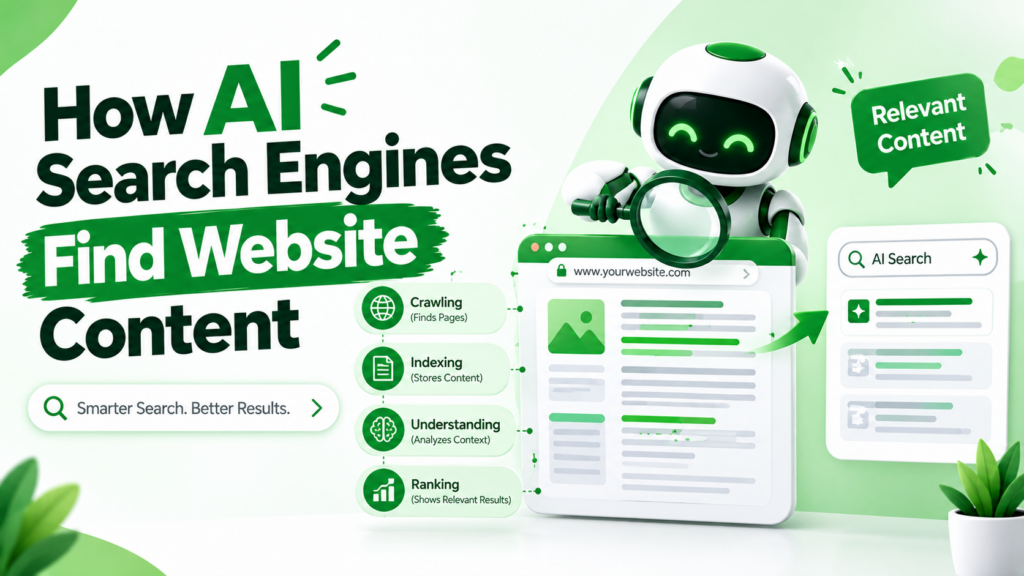
Different AI search platforms use different technologies, but website accessibility, relevance, and content quality remain important.
1. Improve Crawling and Discoverability
Search engines and AI-related crawlers need access to your website before they can discover its content.
If important pages are blocked, poorly linked, or unavailable to crawlers, they may be difficult to discover.
For ChatGPT search visibility, OpenAI provides guidance around OAI-SearchBot, while Perplexity identifies PerplexityBot as a crawler used to discover and link web content.
You should:
- Check your
robots.txtfile. - Avoid accidentally blocking important pages.
- Submit your sitemap through Google Search Console.
- Use internal links between related pages.
- Fix broken links.
- Reduce unnecessary redirects.
Useful resource: Google Search Console can help you monitor indexing, search performance, and technical issues.
2. Focus on Indexing and Search Eligibility
Your content needs to be accessible and indexable before it can potentially appear in search experiences.
Google’s guidance indicates that there are no separate technical requirements or special schema markup specifically required for AI Overviews. Existing SEO fundamentals remain important.
Make sure your website has:
- Clear page structure.
- Helpful and original content.
- Descriptive headings.
- Mobile-friendly design.
- Good website performance.
- Accurate metadata.
- Strong internal linking.
7 Effective AI Search Optimization Strategies
1. Create Helpful and Original Content
The foundation of AI search optimization is high-quality content that provides genuine value.
Avoid creating generic articles that simply repeat information found on hundreds of other websites. Instead, add something useful and unique.
Your content can include:
- Original examples.
- Practical instructions.
- Expert explanations.
- Comparisons.
- Updated information.
- Common mistakes.
- Solutions to real problems.
- Industry-specific insights.
For example, instead of writing:
“SEO is important for websites.”
you could explain exactly how a small business can improve visibility through service pages, internal linking, optimized titles, technical SEO, and useful customer-focused content.
Google emphasizes people-first content that provides value rather than content created primarily to manipulate search rankings.
Internal link opportunity: Add a link to your existing SEO & Digital Marketing Guide here.
2. Answer User Questions Clearly
AI search users often ask conversational questions, so your content should provide direct answers.
Useful question-based headings include:
- What is AI Search Optimization?
- How does AI search work?
- How can I optimize my website for ChatGPT?
- What are AI search optimization tools?
- Does traditional SEO still matter for AI search?
A simple content structure is:
Question → Short answer → Detailed explanation → Example
This makes your article easier to scan and helps readers quickly find the information they need.
3. Optimize Your Website for ChatGPT and Perplexity
If your goal is to optimize website for ChatGPT Perplexity AI search visibility, focus on accessibility, relevance, authority, and useful information.
Follow these steps:
- Publish original and helpful content.
- Keep important pages publicly accessible.
- Avoid unintentionally blocking relevant crawlers.
- Use descriptive titles and headings.
- Add relevant internal links.
- Keep business information accurate.
- Update outdated content.
- Build genuine authority through quality references and mentions.
There is no secret technique that guarantees inclusion in AI-generated answers. Instead, make your website a useful and trustworthy source that search systems can discover and understand.
External resources: OpenAI Publisher & Developer FAQ and Perplexity Crawler Documentation can help you understand crawler access.
4. Use Structured Data Correctly
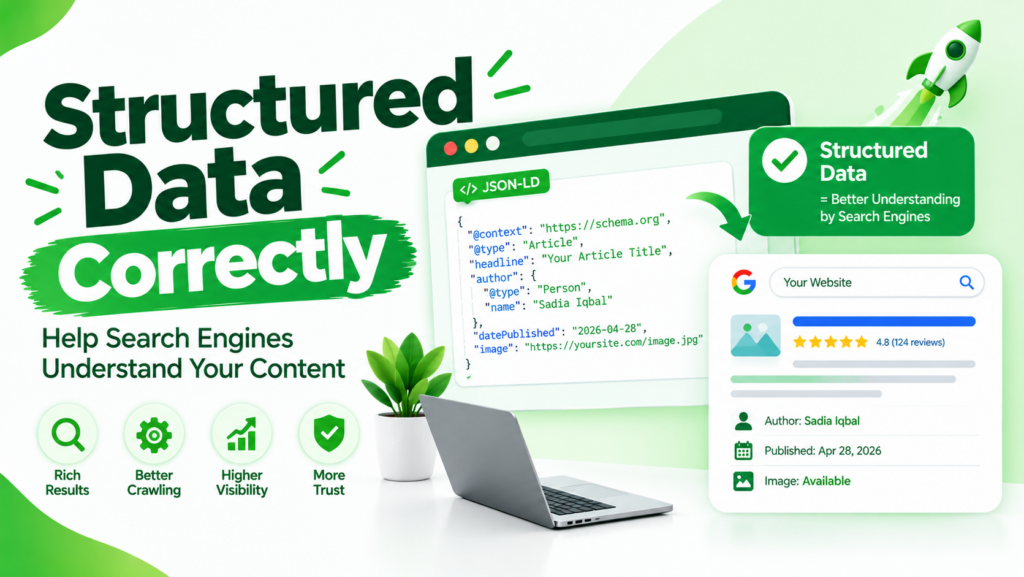
Structured data helps search engines understand specific information on your pages.
Depending on your website, relevant structured data may include:
- Article schema.
- Organization schema.
- LocalBusiness schema.
- Product schema.
- Breadcrumb schema.
- FAQ-related structured data where applicable.
However, adding schema does not automatically make a page appear in AI results.
Google has stated that there is no special schema markup specifically required for AI Overviews or AI Mode.
The best practice is to make sure your structured data accurately represents the visible information on the page.
Internal link opportunity: Link to your existing WordPress SEO Guide from this section.
5. Build a Strong Internal Linking Structure
Internal links help users and search engines discover related content. They also help establish relationships between different topics on your website.
For example, an AI Search Optimization article could link to:
- SEO guides.
- WordPress SEO articles.
- Website development guides.
- Website maintenance resources.
- Website speed optimization articles.
Use descriptive anchor text instead of generic phrases such as “click here.”
For example:
“Learn more about improving website visibility with our WordPress SEO Plugins” Guide.
Make sure the anchor text and destination page are genuinely relevant.
6. Improve Technical SEO
Technical SEO remains an essential part of AI search engine optimization.
Even excellent content can struggle if search engines cannot properly access, crawl, or understand your website.
Check the following:
- Is your website mobile-friendly?
- Are important pages indexable?
- Is HTTPS enabled?
- Is your XML sitemap working?
- Are there broken links?
- Does your website load efficiently?
- Is important content available in HTML?
- Are canonical tags configured correctly?
- Is your website easy to navigate?
A strong technical foundation makes it easier for search engines and other systems to discover and interpret your content.
Useful resource: Google Search Essentials
7. Build Trust and Demonstrate Expertise
Trust is an important part of modern search visibility.
Your website should clearly communicate who created its content and why visitors should trust your business.
Consider adding:
- Author information.
- An About Us page.
- Contact information.
- Business details.
- Relevant references.
- Updated publication dates.
- Clear product or service information.
For business websites, keeping company information accurate and consistent across relevant online profiles can also support credibility.
What Are AI Search Optimization Tools?
AI search optimization tools can help businesses research topics, identify technical issues, analyze content, monitor search performance, and discover opportunities.
There is no single tool that guarantees AI search visibility. Different tools serve different purposes.
| Tool Category | What It Helps With |
|---|---|
| Keyword Research Tools | Find keywords, topics, and search opportunities |
| SEO Audit Tools | Identify technical SEO problems |
| Content Tools | Improve content structure and readability |
| Search Console | Monitor indexing and Google search performance |
| Analytics Tools | Track traffic and conversions |
| Schema Tools | Validate structured data |
Some commonly used platforms include:
- Semrush — keyword research, competitor analysis, and SEO audits.
- Ahrefs — keyword research, backlink analysis, and content research.
- Google Search Console — indexing and search performance.
- Google Analytics — traffic and user behavior analysis.
- Screaming Frog SEO Spider — technical SEO crawling and auditing.
Remember that tools provide data and recommendations, but human judgment is still important when creating useful content and deciding what your audience actually needs.
AI Search Optimization vs Traditional SEO
AI search optimization and traditional SEO are closely connected.
The main difference is how users discover and consume information.
| Traditional SEO | AI Search Optimization |
|---|---|
| Focuses on search engine results | Focuses on AI-powered search experiences and search |
| Targets keywords and queries | Targets questions, topics, entities, and user needs |
| Focuses heavily on rankings and clicks | Focuses on discoverability and potential references |
| Uses technical SEO and content | Uses the same foundation with stronger emphasis on clear answers |
The important point is that AI search optimization does not replace SEO. Traditional SEO fundamentals remain an important foundation for modern AI-powered search experiences.
Common AI Search Optimization Mistakes
Keyword Stuffing
Repeating the phrase “AI search optimization” unnaturally can make your content difficult to read. Use your focus keyword naturally and include related terms where they genuinely fit.
Publishing Large Amounts of Low-Value AI Content
Using AI to produce content is not a substitute for expertise, research, originality, and editing. Large volumes of low-value content can create quality problems.
Believing in Guaranteed AI SEO Hacks
Be cautious of claims that a single file, secret prompt, special schema code, or one-time optimization can guarantee AI search visibility.
Ignoring Traditional SEO
AI search optimization still depends heavily on fundamentals such as crawlability, indexing, website performance, useful content, and internal linking.
Writing Only for Search Engines
Your primary goal should be to solve the reader’s problem. When content is genuinely useful, it has a stronger foundation for visibility across different search experiences.
AI Search Optimization Checklist
Before publishing or updating your content, check the following:
- Focus keyword is included in the title.
- Focus keyword appears naturally in the first paragraph.
- URL is short and descriptive.
- Meta description matches the search intent.
- Main question is answered clearly.
- Related keywords are used naturally.
- Headings are descriptive.
- Internal links are included.
- External sources are relevant and trustworthy.
- Images have useful alt text.
- Website is mobile-friendly.
- Important pages are indexable.
- Content is original and useful.
- Facts and statistics have been reviewed.
- Outdated information has been updated.
Frequently Asked Questions
What is AI Search Optimization?
AI Search Optimization is the process of improving website content, technical SEO, accessibility, and credibility so that a website can be discovered and potentially referenced by AI-powered search experiences.
How do I optimize my website for ChatGPT and Perplexity?
Create helpful content, keep important pages accessible, avoid unintentionally blocking relevant crawlers, use clear headings, improve technical SEO, add internal links, and provide trustworthy information.
What are AI search optimization tools?
AI search optimization tools include keyword research platforms, SEO auditing software, content analysis tools, Google Search Console, and analytics platforms that help improve website visibility and performance.
Is AI Search Optimization the same as SEO?
They are closely related but not identical. Traditional SEO focuses broadly on search engine visibility, while AI Search Optimization focuses more specifically on visibility within AI-powered search experiences. Both rely on strong technical SEO and helpful content.
Does Google require special AI SEO schema?
Google states that there is no special schema markup required specifically for AI Overviews or AI Mode. Website owners should continue using accurate structured data and following standard SEO best practices.
Final Thoughts
AI Search Optimization is becoming an important part of modern digital marketing. However, the fundamentals remain straightforward: create helpful content, maintain a technically sound website, answer real user questions, and build trust.
Businesses should avoid chasing shortcuts or guaranteed AI search hacks. Instead, focus on creating original information that people actually want to read and search systems can easily understand.
Start by improving your existing content, strengthening internal links, fixing technical SEO issues, updating outdated information, and monitoring performance with reliable SEO tools.
When your website consistently provides clear, accurate, and useful answers, you create a strong foundation for visibility across traditional search engines and emerging AI-powered search experiences in 2026.